




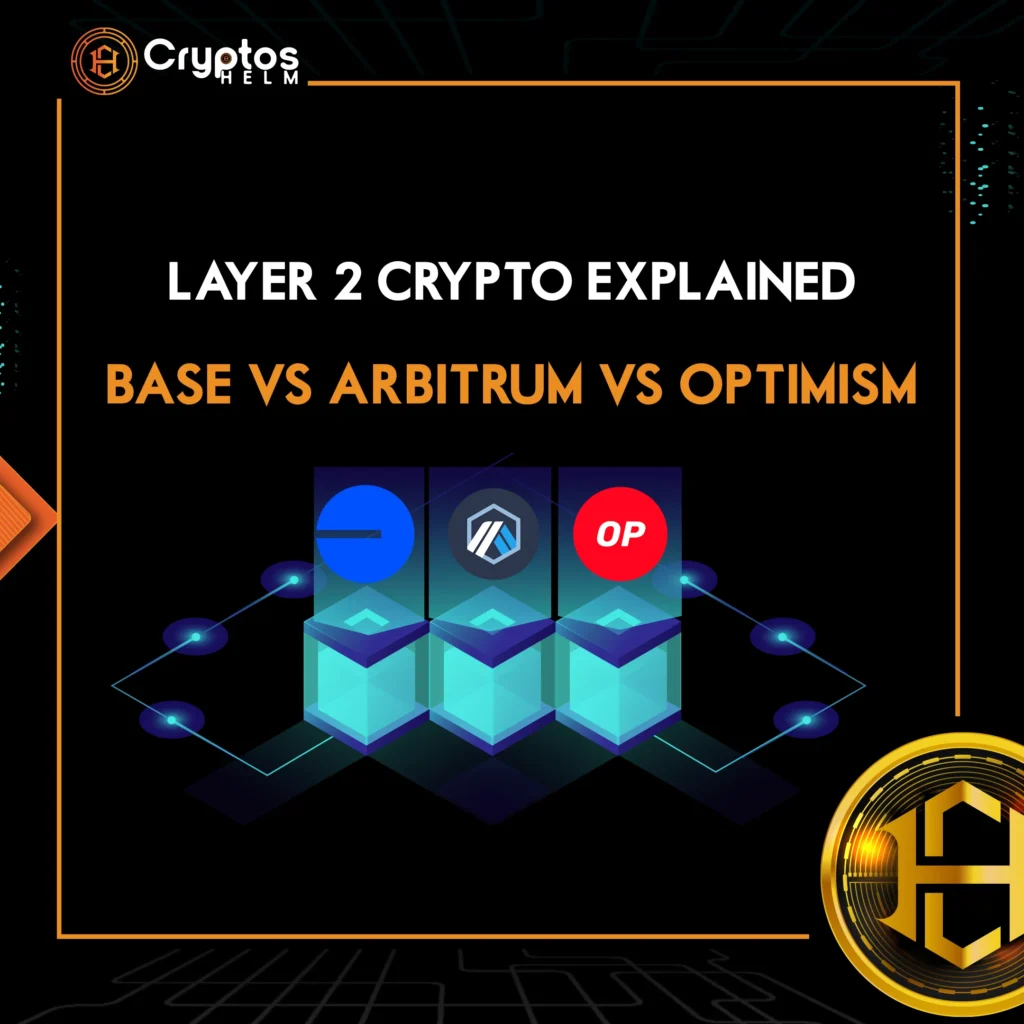
Introduction Base vs Arbitrum vs Optimism
Ethereum’s scalability challenges have been a persistent bottleneck for blockchain adoption, with high gas fees and slow transaction speeds limiting its potential. Enter Layer 2 scaling solutions—the game-changing technology that’s revolutionizing how we interact with blockchain networks. In 2025, three networks are leading this transformation: Base, Arbitrum, and Optimism.
This comprehensive guide breaks down everything you need to know about these Layer 2 powerhouses, helping you understand which solution best fits your needs.
What Are Layer 2 Scaling Solutions?
Before diving into the comparison, let’s understand what Layer 2 solutions actually are. Think of Layer 1 (Ethereum mainnet) as a busy highway during rush hour—congested, slow, and expensive to use. Layer 2 solutions are like express lanes built above this highway, processing transactions off the main chain while still maintaining the security and decentralization of Ethereum.
These scaling solutions process transactions in batches off-chain before settling them on Ethereum’s mainnet. This approach dramatically reduces network congestion, slashes transaction fees by up to 90-98%, and increases throughput from Ethereum’s 15-30 transactions per second (TPS) to thousands of TPS.
Key Benefits of Layer 2 Networks:
- Scalability: Handle 1,000+ TPS compared to Ethereum’s 15-30 TPS
- Cost Reduction: Transaction fees as low as $0.01 versus Ethereum’s $5-$50+
- Speed: Near-instant transaction finality (2-3 seconds)
- Security: Inherit Ethereum’s robust security infrastructure
- EVM Compatibility: Seamless migration for existing Ethereum dApps
Understanding the Technology: Optimistic Rollups
Both Arbitrum, Optimism, and Base utilize Optimistic Rollup technology—a Layer 2 scaling approach that assumes all transactions are valid by default. Here’s how it works:
- Transaction Bundling: Multiple transactions are batched together off-chain
- Optimistic Assumption: Transactions are assumed valid unless challenged
- Fraud Proofs: A dispute resolution mechanism validates suspicious transactions
- Mainnet Settlement: Compressed transaction data is posted to Ethereum
This mechanism significantly reduces the computational burden on Ethereum’s mainnet while maintaining its security guarantees.
Arbitrum: The DeFi Powerhouse
Overview
Launched in August 2021 by Offchain Labs, Arbitrum has established itself as the dominant force in the Layer 2 ecosystem. As of November 2025, Arbitrum leads all Layer 2 networks with $16.63 billion in Total Value Locked (TVL), representing its strong position in decentralized finance.
Technical Architecture
Arbitrum operates on the Arbitrum Virtual Machine (AVM), which introduces an additional abstraction layer beyond the standard Ethereum Virtual Machine (EVM). This design enables:
- Multi-round Fraud Proofs: Enhanced security through interactive dispute resolution
- Higher Efficiency: Optimized transaction batching and execution
- Full EVM Compatibility: Seamless deployment of Solidity smart contracts
Performance Metrics (2025)
- Transactions Per Second: 40-60 TPS
- Daily Active Wallets: 1.37 million (November 2025)
- Total Value Locked: $16.63 billion
- DeFi Protocols: 600+ decentralized applications
- Block Time: 2 seconds with ~20% faster finality than competitors
Ecosystem & Use Cases
Arbitrum has become the go-to platform for serious DeFi projects:
- Major Protocols: Uniswap, Aave, Balancer, Curve Finance
- Gaming & NFTs: TreasureDAO cultivating gaming ecosystem
- Layer 3 Solutions: Arbitrum Orbit enabling custom chains
- Governance: ARB token powers decentralized governance through ArbitrumDAO
Strengths
- Largest TVL and most mature DeFi ecosystem
- Multi-round fraud proofs provide enhanced security
- Strong developer community and comprehensive documentation
- Proven track record since 2021
- Lower gas fees through efficient transaction processing
Considerations
- Longer dispute resolution process due to multi-round fraud proofs
- Higher technical complexity for developers
- Finality can take longer during disputes
Optimism: The Infrastructure Innovator
Overview
Launched in December 2021, Optimism pioneered the “Superchain” concept—a vision of interconnected Layer 2 networks sharing security and liquidity. With $6 billion TVL as of November 2025, Optimism focuses on building foundational infrastructure for Ethereum’s scaling future.
Technical Architecture
Optimism runs on the Optimistic Virtual Machine (OVM), designed for maximum compatibility with Ethereum:
- Single-round Fraud Proofs: Faster dispute resolution process
- OP Stack Framework: Open-source toolkit for building Layer 2 networks
- Modular Design: Enables customization and interoperability
Performance Metrics (2025)
- Transactions Per Second: 130 TPS (highest among the three)
- Total Value Locked: $6 billion
- DeFi Protocols: 200+ decentralized applications
- Block Time: 2 seconds
- Gas Fee Reduction: 90% lower than Ethereum mainnet
The Superchain Vision
Optimism’s most innovative contribution is the Superchain—a network of interconnected Layer 2 chains:
- Base Integration: Coinbase’s Base built on OP Stack
- Shared Liquidity: Assets flow seamlessly across connected chains
- Unified Security: All chains benefit from Ethereum’s security
- Revenue Sharing: Base contributes 2.5% sequencer revenue to Optimism
Governance Model
Optimism employs a unique bicameral governance structure:
- Token House: OP token holders vote on protocol upgrades and treasury allocation
- Citizens’ House: Non-transferable NFT holders govern retroactive public goods funding
Strengths
- Highest throughput (130 TPS) among the three
- Single-round fraud proofs enable quicker finality
- Superchain creates network effects and shared liquidity
- Strong focus on public goods funding
- Open-source OP Stack empowers ecosystem growth
Considerations
- Smaller TVL compared to Arbitrum
- Less focus on individual DeFi dominance
- Single-round fraud proofs may have security trade-offs
Base: The Mass Adoption Catalyst
Overview
Launched in August 2023 by Coinbase, Base represents the newest yet fastest-growing Layer 2 solution. Built on Optimism’s OP Stack, Base achieved $10 billion TVL by November 2025, demonstrating explosive growth driven by Coinbase’s massive user base.
Technical Architecture
Base leverages proven Optimism technology while adding Coinbase’s infrastructure:
- OP Stack Foundation: Inherits Optimism’s battle-tested framework
- EVM Compatibility: Full support for Ethereum smart contracts
- Hybrid Approach: Combines optimistic rollups with user-friendly design
- Fiat On-ramps: Direct integration with Coinbase exchange
Performance Metrics (2025)
- Transactions Per Second: 85 TPS (processing 55% of all L2 transaction volume)
- Total Value Locked: $10 billion
- Weekly Transactions: 67 million
- Weekly Active Users: 1.74 million (with 30% week-over-week growth)
- Daily Transactions: Record 13.39 million (January 2025)
Strategic Advantages
Base’s unique positioning comes from Coinbase’s infrastructure:
- 100M+ User Base: Direct access to Coinbase’s verified users
- Instant Onboarding: Less than 60-second setup with Smart Wallet
- USDC Integration: Virtually free stablecoin transfers
- No Seed Phrases: Smart contract wallets simplify user experience
- Marketing Power: $165M+ quarterly marketing spend driving adoption
Ecosystem Growth
Base achieved rapid ecosystem development:
- DeFi: Aerodrome Finance ($1.68B volume), Uniswap, AAVE, Morpho ($1.89B TVL)
- NFTs: 70% surge in trading volume to $47.67M (August 2025)
- Memecoins: Major hub for community-driven tokens
- Social Platforms: Farcaster and other on-chain social applications
- Stablecoins: 30% of U.S. stablecoin transactions processed on Base
Onchain Summer Success
Base’s promotional campaigns drove explosive growth:
- 2.2 million unique wallets participated (8x year-over-year growth)
- Record-breaking transaction volumes
- Successful onboarding of mainstream users
Strengths
- Fastest-growing Layer 2 with institutional backing
- Seamless Coinbase integration and fiat on-ramps
- Lowest barrier to entry for new crypto users
- Strong momentum in NFTs and consumer applications
- Partnership with Optimism Superchain
Considerations
- Centralization concerns under Coinbase control
- Newer network with less battle-tested infrastructure
- Potential regulatory scrutiny due to Coinbase association
- No native token (as of November 2025, though exploration announced)
Head-to-Head Comparison
Total Value Locked (TVL)
| Network | TVL (Nov 2025) | Market Position |
|---|---|---|
| Arbitrum | $16.63 billion | #1 Layer 2 |
| Base | $10 billion | #2 Layer 2 |
| Optimism | $6 billion | #3 Layer 2 |
Transactions Per Second
| Network | TPS | Use Case Optimization |
|---|---|---|
| Optimism | 130 TPS | High-throughput applications |
| Base | 85 TPS | Mass retail adoption |
| Arbitrum | 40-60 TPS | DeFi complexity |
Transaction Costs
All three networks offer dramatically lower fees than Ethereum mainnet:
- Ethereum: $5-$50+ per transaction
- Layer 2s: $0.01-$0.08 per transaction (90-98% reduction)
Post-EIP-4844 Dencun upgrade, all three networks benefit from even cheaper data availability costs.
Security Model
| Feature | Arbitrum | Optimism | Base |
|---|---|---|---|
| Fraud Proofs | Multi-round | Single-round | Single-round |
| Dispute Time | Longer | Faster | Faster |
| Security Level | Enhanced | Standard | Standard |
Developer Ecosystem
| Network | Protocols | Developer Focus |
|---|---|---|
| Arbitrum | 600+ | DeFi, Gaming, Layer 3 |
| Optimism | 200+ | Infrastructure, Public Goods |
| Base | 617+ | Consumer Apps, Social, NFTs |
Which Layer 2 Should You Choose?
Choose Arbitrum If:
- Complex DeFi protocols require dependable scaling
- Multi-round fraud proofs ensure the security level you need
- Deep liquidity and a mature DeFi ecosystem support your product
- Gaming and NFT projects benefit from robust, low-latency performance
- Crypto-native users demand high reliability and low fees
Choose Optimism If:
- Infrastructure-level development aligns with your goals
- Open-source collaboration and public goods shape your priorities
- Superchain network effects enhance your project’s reach
- High throughput (130 TPS) is necessary for your use case
- Cross-chain functionality is integral to your design
Choose Base If:
- Mainstream adoption and new-user onboarding are central to your plan
- Coinbase’s user base and fiat on-ramps strengthen your foundation
- Consumer-facing apps, NFTs, or social products are being developed
- Simple onboarding improves your expected user flow
- Stablecoin transactions (like USDC) fit your model
- Meme-centric or viral growth supports your marketing
The Future of Layer 2 in 2025 and Beyond
The Layer 2 landscape is rapidly evolving with several key trends:
1. Zero-Knowledge Rollups Rising
While Arbitrum, Optimism, and Base use optimistic rollups, ZK-rollups (zkSync, Starknet) are gaining momentum with:
- Faster finality without waiting periods
- Enhanced privacy features
- Cryptographic proof-based security
2. Interoperability Advances
Projects like Optimism’s Superchain and Arbitrum Orbit are building connected Layer 2 ecosystems:
- Shared liquidity across networks
- Seamless cross-chain communication
- Unified user experiences
3. Institutional Adoption
Layer 2s are attracting traditional finance:
- Franklin Templeton tokenizing funds on Base
- 86% of institutional investors holding or planning crypto investments
- 30-40% operational cost reduction using Layer 2 infrastructure
4. Sequencer Decentralization
Current centralization concerns are being addressed:
- 30% of Layer 2 projects actively working on decentralization
- Plans for distributed sequencer networks
- Enhanced censorship resistance
Frequently Asked Questions (FAQs)
1. What is the main difference between Layer 1 and Layer 2 blockchains?
Layer 1 blockchains like Ethereum are the base networks where all transactions are directly recorded and validated. Layer 2 solutions are built on top of Layer 1, processing transactions off-chain in batches before settling them on the main blockchain. This approach reduces congestion and costs while maintaining the security of the underlying Layer 1 network. Layer 2s can process 1,000+ transactions per second compared to Ethereum’s 15-30 TPS, with fees as low as $0.01 versus Ethereum’s $5-$50+ per transaction.
2. Are Layer 2 networks as secure as Ethereum mainnet?
Yes, Layer 2 solutions like Arbitrum, Optimism, and Base inherit Ethereum’s security through their design. They periodically post transaction data to Ethereum’s mainnet, ensuring that users can always verify transactions and recover funds if needed. Optimistic rollups use fraud proofs to challenge invalid transactions, while the underlying transaction data remains available on Ethereum. This means Layer 2s provide similar security guarantees to Ethereum while offering dramatically improved performance.
3. How long does it take to transfer assets from Layer 2 back to Ethereum mainnet?
Withdrawal times vary depending on the Layer 2 network’s fraud proof mechanism. For optimistic rollups like Arbitrum, Optimism, and Base, withdrawals typically take 7 days to finalize. This waiting period allows time for potential fraud proofs to be submitted and resolved. However, many users utilize third-party bridges and liquidity providers that offer instant withdrawals in exchange for a small fee, eliminating the need to wait the full dispute period.
4. Which Layer 2 has the lowest transaction fees?
All three networks offer comparable transaction fees ranging from $0.01 to $0.08, representing a 90-98% reduction compared to Ethereum mainnet. After the EIP-4844 Dencun upgrade implemented in 2024, fees across all Layer 2 networks dropped significantly. Base often has the lowest fees for stablecoin transfers (especially USDC), which are nearly free. The actual cost depends on network congestion and transaction complexity, but all three networks provide dramatically cheaper transactions than Ethereum Layer 1.
5. Can I use MetaMask and other Ethereum wallets with Layer 2 networks?
Yes, all three Layer 2 networks are fully compatible with popular Ethereum wallets like MetaMask, Coinbase Wallet, WalletConnect, and hardware wallets. You simply need to add the Layer 2 network to your wallet settings (which is often automatic) and bridge assets from Ethereum mainnet. Base offers an additional option—Coinbase Smart Wallet—which eliminates seed phrases and provides the simplest onboarding experience, making it ideal for newcomers to crypto.
6. Do Base, Arbitrum, and Optimism have their own tokens?
Arbitrum has the ARB token, which is used for governance and allows holders to vote on protocol decisions through the ArbitrumDAO. Optimism has the OP token, which serves similar governance purposes in both the Token House and provides rewards through retroactive public goods funding. Base does not currently have a native token and uses ETH for gas fees. However, in September 2025, Coinbase announced it is “exploring” a potential Base token, though no definitive plans have been released. All three networks use ETH as their primary gas token for transaction fees.
Final Thoughts
Base, Arbitrum, and Optimism represent different approaches to solving Ethereum’s scalability challenge, each with distinct strengths:
- Arbitrum dominates DeFi with the largest TVL and most mature ecosystem
- Optimism pioneers infrastructure innovation with the Superchain vision
- Base drives mass adoption through Coinbase integration and user-friendly design
Rather than a winner-takes-all scenario, these Layer 2 solutions are creating a multi-chain future where users benefit from choice, competition, and specialization. As of 2025, Layer 2 networks process 5x more transactions than Ethereum mainnet, with over 65% of new smart contracts deployed on Layer 2 platforms.
The question isn’t which Layer 2 will win—it’s which combination of Layer 2 solutions will best serve your specific needs. DeFi protocols, Arbitrum’s deep liquidity is unmatched. For infrastructure projects, Optimism’s Superchain offers unparalleled opportunities. For consumer applications, Base’s Coinbase integration provides the easiest path to mainstream users.
As blockchain technology continues evolving toward mass adoption, Layer 2 solutions aren’t just improvements—they’re the foundation for a scalable, accessible, and sustainable decentralized future.