




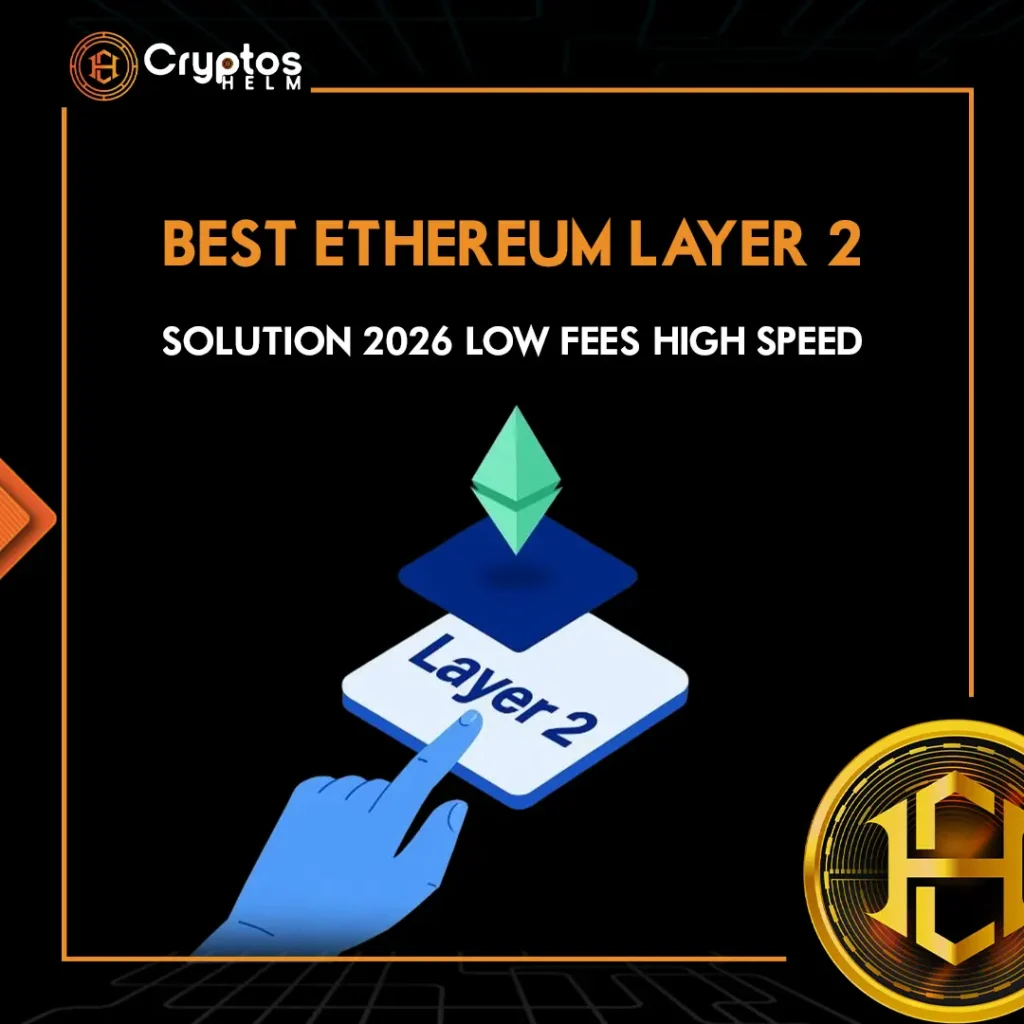
Why Ethereum Needs Layer 2 in 2026
Ethereum is the world’s most powerful smart contract blockchain battle-tested, decentralized, and home to trillions of dollars in on-chain value. But it has one persistent bottleneck: transaction fees spike dramatically during high-demand periods.
In 2021, simple token swaps cost $50–$200 in gas fees, locking out everyday users from DeFi, NFTs, and Web3 applications. That problem did not go away on its own it was engineered away by a new generation of Layer 2 networks.
By 2026, Ethereum Layer 2 solutions collectively process millions of transactions daily at fees as low as $0.001 per transaction — a 99%+ reduction compared to Layer 1. If you are using Ethereum without a Layer 2, you are overpaying.
What this guide covers: The 5 best Ethereum Layer 2 solutions in 2026 how each works, real fee comparisons, who each is best suited for, and the key risks every user must understand before bridging funds.
What Is Ethereum Layer 2? A Clear Explanation
Ethereum Layer 2 (L2) refers to secondary blockchain networks built on top of Ethereum’s main chain (Layer 1). These networks process transactions independently, then periodically settle final results back onto Ethereum — inheriting its security while avoiding its congestion.
A simple analogy: Layer 1 (Ethereum) is a busy city highway secure and trustworthy, but expensive and slow during peak hours. Layer 2 networks are express lanes built alongside faster and cheaper, but still connected to the same main road.
How a Layer 2 Transaction Works
- You initiate a transaction on the Layer 2 network
- Thousands of transactions are bundled together into a batch
- The batch is compressed using rollup technology and submitted to Ethereum mainnet
- Ethereum verifies the batch — providing full security guarantees
- You pay a small fraction of normal Ethereum gas fees
This process is called a rollup — and it is the foundation of every major Layer 2 in 2026.
Optimistic Rollups vs. ZK Rollups: What’s the Difference?
Before choosing a Layer 2, you need to understand the two verification approaches — because they have real tradeoffs that affect your daily experience.
Optimistic Rollups
Optimistic rollups assume transactions are valid by default. They only run a verification check if someone challenges a transaction during a dispute window. This makes them simpler to build and easier for Ethereum apps to deploy on without changes.
- Examples: Arbitrum, Optimism
- Strengths: Full EVM compatibility, large ecosystems, deep liquidity
- Tradeoff: 7-day withdrawal window back to mainnet (without third-party fast bridges)
ZK Rollups (Zero-Knowledge)
ZK rollups use cryptographic proofs to mathematically verify every single transaction before it is submitted to Ethereum. There is no trust assumption and no challenge period required.
- Examples: zkSync Era, Polygon zkEVM, StarkNet
- Strengths: Near-instant withdrawals, stronger mathematical security
- Tradeoff: More complex to build on, historically smaller ecosystems (growing fast in 2026)
Quick rule: If you prioritize ecosystem size and liquidity → choose an Optimistic rollup. If you prioritize security and fast withdrawals → choose a ZK rollup.
Best Ethereum Layer 2 Solutions 2026
After evaluating total value locked (TVL), transaction fees, developer activity, security track record, and ecosystem maturity, these are the five leading Layer 2 networks in 2026.
1. Arbitrum Largest Layer 2 Ecosystem
Type: Optimistic Rollup | Token: ARB | TVL: $15B+
Arbitrum, developed by Offchain Labs, is the most widely used Ethereum Layer 2 by total value locked in 2026. It earned its position not through aggressive marketing, but through consistent reliability, deep liquidity, and the trust of the largest DeFi protocols in the space.
Major protocols including Uniswap, Aave, GMX, Curve, and Radiant Capital all run on Arbitrum — meaning you can access virtually every major DeFi service with Ethereum-grade security at a fraction of the cost.
Key Facts:
- $15B+ TVL — largest Layer 2 ecosystem by locked value
- 400+ deployed dApps including blue-chip DeFi protocols
- Average transaction fee: $0.01–$0.10
- Throughput: 2,000+ TPS
- Full EVM compatibility — any Ethereum app deploys without code changes
Real Fee Comparison: A token swap that costs $15–$50 on Ethereum mainnet during peak congestion costs approximately $0.05–$0.15 on Arbitrum. For active DeFi users executing multiple transactions per week, annual savings easily exceed $500–$2,000 compared to mainnet.
Who Should Use Arbitrum: DeFi users, active traders, and anyone who values liquidity depth. If you want the widest selection of protocols, the deepest trading pools, and a proven track record managing billions in user funds — Arbitrum is the default answer.
2. Optimism The Superchain and Ultra-Low Fees
Type: Optimistic Rollup | Token: OP | TVL: $8B+
Optimism is more than a Layer 2 — it is the foundation of the Superchain: a growing network of interconnected L2 chains all built on the open-source OP Stack framework. Coinbase’s Base network runs on OP Stack, as do 20+ other chains in 2026, making Optimism’s broader ecosystem rival Arbitrum in total daily activity.
The EIP-4844 upgrade in 2024 was a turning point for Optimism. By introducing “blob” data availability, it reduced L2 data submission costs to Ethereum by over 90%. Simple transfers on Optimism now cost less than $0.001 — making it the most affordable Optimistic rollup available.
Key Facts:
- $8B+ TVL across Optimism mainnet and the broader OP Stack ecosystem
- Powers Coinbase Base — one of the fastest-growing Layer 2 networks in 2026
- Average fee: $0.001–$0.05
- Retroactive Public Goods Funding model incentivizes open-source development
- OP Stack is open source — any team can launch their own L2 using it
Who Should Use Optimism: Users who want the absolute lowest fees on an Optimistic rollup, developers building new L2 chains, and anyone who uses Coinbase or prefers a regulated, institutional-grade entry point into the Ethereum ecosystem through Base.
3. zkSync Era — Leading ZK Rollup
Type: ZK Rollup | Token: ZK | TVL: $4B+
zkSync Era by Matter Labs is the most mature and widely used ZK rollup in 2026. Unlike Optimistic rollups, zkSync does not assume transactions are valid — it mathematically proves every transaction using zero-knowledge cryptography before submitting to Ethereum. This eliminates the challenge period entirely.
One feature that sets zkSync apart from all other Layer 2 solutions is native Account Abstraction. Instead of requiring users to hold ETH to pay gas, zkSync allows gas payment in any supported token. Users can also set spending limits, batch multiple actions into one transaction, and recover wallets without a seed phrase — fundamentally improving the everyday user experience.
Key Facts:
- Zero-knowledge proof verification — mathematically guaranteed security
- Instant withdrawals — no 7-day waiting period unlike Optimistic rollups
- Average fee: $0.001–$0.03
- 3,000+ TPS throughput
- Native Account Abstraction built into the protocol layer
- ZK governance token launched 2024 with active community participation
Who Should Use zkSync Era: Security-conscious users, anyone who needs to move funds quickly back to mainnet, and developers interested in next-generation wallet experiences through Account Abstraction.
4. Polygon zkEVM — Enterprise-Grade Layer 2
Type: ZK Rollup | Token: POL | TVL: $3B+
Polygon zkEVM distinguishes itself with one critical feature: full Ethereum Virtual Machine (EVM) equivalence. Any smart contract written for Ethereum mainnet can be deployed on Polygon zkEVM without any code modifications. This is not just EVM compatibility — it is EVM equivalence, a higher standard ensuring byte-for-byte parity with Ethereum’s execution environment.
This technical precision, combined with Polygon’s established enterprise relationships, makes it the preferred Layer 2 for institutional deployments in 2026. Brands including Starbucks, Nike, Reddit, and financial institutions piloting with JP Morgan have leveraged Polygon’s infrastructure.
Key Facts:
- Full EVM equivalence — highest standard of Ethereum compatibility
- Enterprise partnerships with Fortune 500 companies
- AggLayer connects Polygon, Ethereum, and partner chains into unified liquidity
- POL token — upgraded from MATIC with expanded ecosystem utility
- Average fee: $0.01–$0.05
Who Should Use Polygon zkEVM: Enterprises building production blockchain applications, developers who need guaranteed EVM compatibility with ZK security, and users who want a mature ecosystem backed by institutional partnerships.
5. StarkNet — Most Advanced ZK Cryptography
Type: ZK Rollup (STARK Proofs) | Token: STRK | TVL: $1B+
StarkNet by StarkWare uses a fundamentally different cryptographic approach from every other Layer 2 on this list. While zkSync and Polygon use SNARK proofs (which require a trusted setup), StarkNet uses STARK proofs — which require no trusted setup and are considered theoretically quantum-resistant.
In practical terms, StarkNet’s security does not depend on any external assumption, ceremony, or trusted party. The proofs are transparent and verifiable by anyone. For users and developers who think in decades, STARK proofs represent a meaningful long-term advantage as quantum computing matures.
Key Facts:
- STARK proof system — no trusted setup required, quantum-resistant cryptography
- Cairo programming language — purpose-built for ZK efficiency and performance
- Theoretically unlimited scalability — no hard TPS ceiling
- Average fee: $0.001–$0.02
- 5,000+ TPS potential throughput
Who Should Use StarkNet: Advanced developers who want the most technically sophisticated ZK infrastructure, users who prioritize long-term cryptographic security, and anyone building high-throughput applications that need to scale beyond the limits of other networks.
Layer 2 Comparison Table 2026
| Network | Type | Avg Fee | TPS | TVL | Best For |
|---|---|---|---|---|---|
| Arbitrum | Optimistic Rollup | $0.01–$0.10 | 2,000+ | $15B+ | DeFi, High-Liquidity Trading |
| Optimism / Base | Optimistic Rollup | $0.001–$0.05 | 2,000+ | $8B+ | Low Fees, Coinbase Ecosystem |
| zkSync Era | ZK Rollup | $0.001–$0.03 | 3,000+ | $4B+ | Security, Fast Withdrawals |
| Polygon zkEVM | ZK Rollup | $0.01–$0.05 | 2,500+ | $3B+ | Enterprise, EVM-Compatible Apps |
| StarkNet | ZK Rollup (STARK) | $0.001–$0.02 | 5,000+ | $1B+ | Advanced Developers, Max Scale |
How to Start Using Ethereum Layer 2 Step by Step
Getting started with any Layer 2 takes less than 10 minutes:
- Set up a wallet — MetaMask or any Web3 wallet works across all Layer 2 networks
- Add the L2 network — visit chainlist.org to add your chosen network in one click
- Bridge your funds — use the official bridge for your chosen L2 to move ETH from mainnet
- Start transacting — use DeFi, NFTs, or send tokens at a fraction of mainnet cost
- Withdraw anytime — bridge back to mainnet whenever needed
Always use official bridges. The majority of historical Layer 2 exploits happened at third-party bridge level. Never use an unofficial bridge with significant funds.
Key Risks Every Layer 2 User Must Understand
Bridge Security Bridge contracts are the most frequently exploited component of Layer 2 systems. Only use official, audited bridges. Never bridge more than you can afford to lose, especially on newer or less-established networks.
Withdrawal Delays Optimistic rollups (Arbitrum, Optimism) enforce a 7-day withdrawal window back to Ethereum mainnet. Fast withdrawal services exist but charge a fee and introduce third-party risk. ZK rollups offer near-instant withdrawals.
Centralized Sequencers In 2026, most Layer 2 networks still use centralized sequencers to order transactions. This is a known tradeoff — it improves performance but means a single operator controls transaction ordering. Decentralized sequencer roadmaps are active for all major networks.
Ecosystem Maturity Smaller networks may have fewer audited dApps, lower liquidity, and higher smart contract risk. Stick to well-established protocols when starting out.
Token Volatility ARB, OP, ZK, POL, and STRK are volatile assets. Network adoption and transaction volume do not guarantee token price appreciation.
Frequently Asked Questions
What is Ethereum Layer 2 and why do I need it?
Ethereum Layer 2 is a secondary network built on top of Ethereum that processes transactions faster and cheaper. Ethereum mainnet fees can reach $10–$200 during congested periods. Layer 2 reduces these to $0.001–$0.10 while maintaining Ethereum’s security.
Which Ethereum Layer 2 has the lowest fees in 2026?
Optimism and StarkNet consistently offer the lowest fees, often below $0.001 for simple transfers. The EIP-4844 upgrade in 2024 reduced L2 data costs by over 90%, benefiting all networks — but Optimism saw the largest fee reduction.
Is it safe to use Ethereum Layer 2 networks?
Established networks like Arbitrum, Optimism, and zkSync have strong security records. The primary risk area is bridge contracts, which have been exploited historically. Always use official bridges, start with small amounts, and verify contract addresses on official websites.
What is the difference between Optimistic and ZK rollups?
Optimistic rollups assume transactions are valid unless challenged — simpler, but require 7-day withdrawal delays. ZK rollups use cryptographic proofs to verify every transaction instantly — more secure with near-instant withdrawals, but more complex to build on.
Do I need a different wallet for Layer 2?
No. Your existing MetaMask or Web3 wallet works on all Ethereum Layer 2 networks. Simply add the L2 network using chainlist.org. Your same Ethereum address is valid on every L2 automatically.
Which Layer 2 is best for beginners in 2026?
Arbitrum is best for beginners due to its largest ecosystem, deepest liquidity, and widest dApp support. Optimism’s Base (powered by Coinbase) is an excellent alternative for users who prefer Coinbase’s familiar, regulated onboarding experience.
Which Layer 2 Should You Choose?
Ethereum Layer 2 solutions have matured significantly by 2026. High fees and slow speeds are no longer valid reasons to avoid Ethereum — these networks handle millions of transactions daily at near-zero cost, secured by the same chain that safeguards hundreds of billions in value.
Quick Recommendation Guide:
| Goal | Best Choice |
|---|---|
| Best overall ecosystem | Arbitrum |
| Lowest fees | Optimism / Base |
| Fastest withdrawals | zkSync Era |
| Enterprise or institutional use | Polygon zkEVM |
| Maximum security & scalability | StarkNet |
You do not have to choose just one. Most experienced users maintain balances on 2–3 Layer 2 networks depending on which protocols they use.
Key Takeaways:
- Layer 2 reduces Ethereum fees by 95–99% while maintaining full security
- Arbitrum leads with $15B+ TVL and 400+ dApps
- ZK rollups offer faster withdrawals and stronger cryptographic guarantees
- EIP-4844 made all L2 fees dramatically cheaper starting in 2024
- Always use official bridges — never unofficial third-party services
- Most L2 networks still use centralized sequencers — decentralization roadmaps are in progress
Ethereum Layer 2 is not just a scaling solution — it is the infrastructure layer through which billions of people will interact with blockchain technology in the years ahead.
About the Author
Sanan Saleem is a cryptocurrency analyst and blockchain technology researcher at CryptosHelm with over 11 years of experience since 2015. He specializes in Ethereum ecosystem analysis, Layer 2 scaling solutions, and DeFi protocol evaluation.
Visit CryptosHelm.com for daily Ethereum updates, Layer 2 news, and blockchain technology analysis.
Disclaimer: This article is for informational purposes only and does not constitute financial advice. Cryptocurrency investments carry significant risks including total loss of capital. Layer 2 networks involve additional smart contract and bridge risks. Always conduct thorough due diligence and never invest more than you can afford to lose.