




If you have spent any time around crypto Twitter, Discord servers, or even the news over the past few years, you have probably asked yourself: what is an NFT, really? You are not alone. It is one of the most searched questions in crypto, and for good reason the term gets thrown around constantly, but very few explanations actually make sense to someone starting from zero.
This guide breaks it down in plain English. No jargon dumps, no assuming you already know what a smart contract is. By the end, you will understand what an NFT actually is, how it works, why people buy them, and whether they are worth your time in 2026.
What is an NFT?
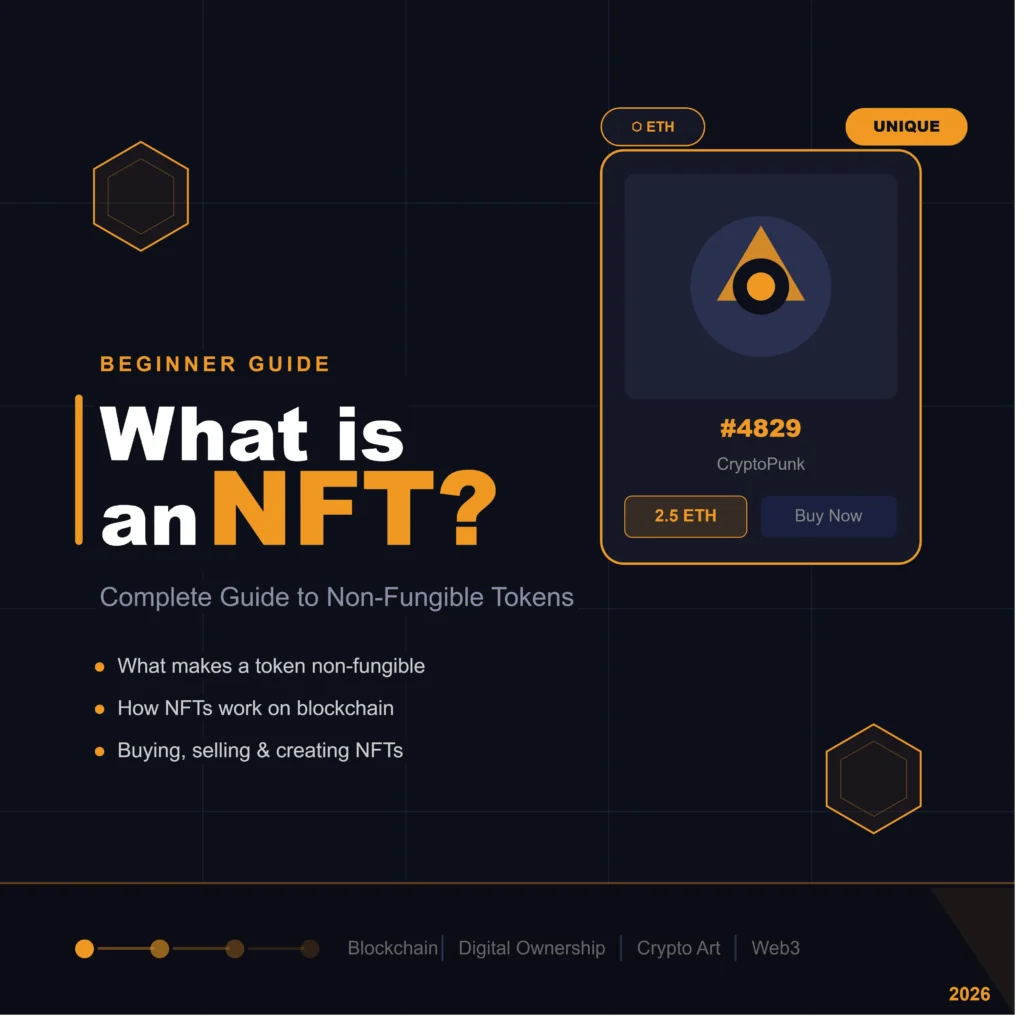
An NFT (non-fungible token) is a unique digital record stored on a blockchain that proves you own a specific item digital or physical. Unlike Bitcoin or Ethereum, where every coin is identical and can be swapped one-for-one, every NFT is one of a kind. That is what “non-fungible” means: it cannot be replaced by something else of equal value.
Think of it this way:
| Fungible (Interchangeable) | Non-Fungible (Unique) |
|---|---|
| A $10 bill any $10 bill works the same | A signed painting only one exists |
| 1 Bitcoin = 1 Bitcoin, anywhere | Your house no other house is identical |
| A movie ticket for any seat | A ticket for seat A12, row 3, specifically |
That comparison is why people keep coming back to the same shorthand: fungible items are interchangeable, non-fungible items are not. An NFT simply takes that idea and puts it on a blockchain, where ownership can be tracked and verified by anyone.
How Does an NFT Actually Work?
Here is where most beginner guides get it wrong. People assume an NFT is the picture, the song, or the video. It usually is not.
In most cases, an NFT is a small piece of code a token that lives on a blockchain and points to a file stored elsewhere (often on a system called IPFS). The token itself contains:
- A unique ID number
- A record of who owns it right now
- A history of every previous owner
- A link to the associated file (image, video, audio, or document)
- Metadata details like the name, description, and traits of the item
So when someone says they “own an NFT,” what they really own is the blockchain record proving they hold that specific token. The token is the proof of ownership. The file is just what it represents.
The Technology Behind It
NFTs run on token standards, most commonly on Ethereum:
| Standard | Best For | How It Works |
|---|---|---|
| ERC-721 | One-of-one items | Each token is completely unique |
| ERC-1155 | Collections with multiple item types | One contract can manage many different assets, like a game with swords, skins, and coins |
Other blockchains Solana, Polygon, Base, and Tezos among them have their own versions of these standards, usually built for speed and lower fees.
Why Do People Actually Buy NFTs?
This is the question almost every beginner asks, and it is a fair one. Why pay real money for something that anyone could technically screenshot for free?
The value of an NFT does not come from the file itself. It comes from a mix of factors:
- Verified ownership Anyone can check the blockchain and confirm exactly who owns a given NFT and who owned it before. That transparency is hard to fake.
- Scarcity Many NFT collections are capped at a fixed number of items, which creates the same scarcity dynamic that drives value in limited-edition sneakers or trading cards.
- Utility Some NFTs unlock real access: event tickets, community memberships, in-game items, or voting rights in a project.
- Community and status Owning a recognizable NFT can act as a social signal, similar to wearing a certain brand.
- Creator support For artists and musicians, NFTs offer a direct way to sell work to fans, often with built-in royalties on future resales.
None of this guarantees an NFT will hold or increase in value. But it explains why the market exists in the first place.
Types of NFTs You Will Come Across
NFTs have expanded well beyond profile picture art. Here is a breakdown of the main categories active in 2026:
| Type | What It Represents | Example |
|---|---|---|
| Art NFTs | Digital paintings, illustrations, generative art | 1/1 artwork, PFP collections |
| Collectibles | Trading-card-style digital items | CryptoPunks, Pudgy Penguins |
| Gaming NFTs | In-game items players actually own | Weapons, skins, land, characters |
| Music NFTs | Limited music releases or fan experiences | Album ownership, unlockable content |
| Domain NFTs | Blockchain-based web addresses | ENS domains |
| Real-World Asset (RWA) NFTs | Tokenized physical items | Trading cards, real estate shares |
| Ticketing & Membership NFTs | Access passes for events or communities | Event tickets, exclusive Discord access |
Gaming and real-world asset NFTs are two of the fastest-growing categories right now, as the space moves away from pure speculation and toward practical use cases like ticketing, identity verification, and ownership of physical collectibles stored off-chain but linked on-chain.
NFT vs Cryptocurrency: What is the Difference?
This trips up a lot of newcomers because both live on a blockchain and both get lumped into “crypto” conversations. But they serve very different purposes.
| Feature | Cryptocurrency | NFT |
|---|---|---|
| Fungibility | Fungible interchangeable | Non-fungible unique |
| Divisibility | Can split into smaller units | Usually cannot be divided |
| Purpose | Medium of exchange, store of value | Proof of ownership of a unique item |
| Example | 1 ETH always equals 1 ETH | Each NFT is one of a kind |
| Used to | Pay for goods, trade, invest | Prove ownership, unlock access, collect |
In practice, you usually need cryptocurrency (like ETH or SOL) to buy an NFT in the first place, since most marketplaces price NFTs in the native token of their blockchain.
How to Buy Your First NFT (Step by Step)
If you are ready to try it yourself, the process is more straightforward than it looks.
- Get a crypto wallet. MetaMask is the standard for Ethereum-based NFTs; Phantom is the go-to for Solana. Download it, set it up, and store your seed phrase somewhere safe and offline.
- Fund your wallet. Buy ETH, SOL, or another relevant token from an exchange and send it to your wallet.
- Choose a marketplace. OpenSea remains the most beginner-friendly option. Blur caters to active traders with lower fees, and Magic Eden dominates Solana and cross-chain NFTs.
- Research before you buy. Check the collection’s trading volume, community activity, and the project team’s track record.
- Connect your wallet and purchase. Once connected, you can buy at a listed price or place a bid, depending on the marketplace.
- Confirm the transaction. You will pay a small network fee (gas) on top of the purchase price, which varies depending on the blockchain.
A simple rule for first-time buyers: treat your first NFT purchase as a learning exercise, not an investment. Understanding the process matters more than the outcome at this stage.
Is Buying an NFT Worth It in 2026?
The honest answer is: it depends on why you are buying one.
Reasons NFTs can make sense:
- You genuinely like the art or the creator and want to support them directly
- You want access to a specific community, event, or in-game feature
- You are experimenting to understand the technology firsthand
Reasons to be cautious:
- NFT prices are highly volatile and can drop sharply after hype fades
- Liquidity can be low some NFTs are hard to resell quickly
- Scams and fake collections are common, especially on social media
- Not every NFT holds long-term value, regardless of its initial price
If you are buying purely to flip for profit, understand that this is a speculative strategy, not a guaranteed return. If you are buying because you value what the NFT represents, the risk profile changes considerably.
Common Mistakes Beginners Make
- Assuming the image is the NFT. In most cases, it is a link to the image, not the file itself.
- Skipping wallet security. Losing your seed phrase means losing access permanently. Sharing it with anyone means losing your funds.
- Buying based on hype alone. Following social media trends without checking a project’s fundamentals is one of the most common ways beginners lose money.
- Ignoring gas fees. On Ethereum especially, network fees can add up quickly during busy periods.
- Not verifying the marketplace or collection link. Fake NFT listings and phishing sites are a real and ongoing risk.
Frequently Asked Questions
What is an NFT in simple terms?
An NFT is a unique digital token stored on a blockchain that proves ownership of a specific digital or physical item. Unlike cryptocurrency, no two NFTs are identical or interchangeable.
What is an NFT used for?
NFTs are used for digital art, gaming items, music releases, event tickets, memberships, domain names, and increasingly, tokenized real-world assets like trading cards or property shares.
Do I own the actual image when I buy an NFT?
Not exactly. You own the blockchain token that proves ownership and usually links to the image or file. The file itself is typically stored separately, often on IPFS.
What is the difference between an NFT and cryptocurrency?
Cryptocurrency is fungible, meaning each unit is identical and interchangeable, like cash. An NFT is non-fungible, meaning it is one of a kind and cannot be swapped for an identical item.
What do I need to buy an NFT?
You need a crypto wallet such as MetaMask or Phantom, some cryptocurrency to cover the purchase and gas fees, and an account on a marketplace like OpenSea, Blur, or Magic Eden.
Are NFTs still relevant in 2026?
Yes, though the market has matured. NFTs are increasingly used for practical purposes like gaming assets, event ticketing, digital identity, and real-world asset verification, rather than purely speculative art trading.
Are NFTs a good investment?
NFTs can gain or lose value quickly and are considered a high-risk asset class. They are best approached with the same caution as any speculative investment, and only with money you can afford to lose.
What blockchain are NFTs built on?
Most NFTs are built on Ethereum using the ERC-721 or ERC-1155 token standards, but NFTs also exist on other blockchains like Solana, Polygon, Base, and Tezos, each offering different fees and transaction speeds.
Can an NFT be copied or stolen?
The file linked to an NFT, like an image, can be copied or screenshotted by anyone. However, the blockchain token that proves official ownership cannot be duplicated. It can only be stolen if someone gains access to your wallet or seed phrase.
How much does it cost to buy or create an NFT?
Costs vary widely by blockchain and marketplace. Buying an NFT depends on its listed price plus network gas fees, while minting one can range from a few cents on low-fee chains like Polygon to over a hundred dollars on Ethereum during busy periods.
Final Thoughts
At its core, an NFT is a simple idea: proof of unique ownership, recorded on a blockchain where anyone can verify it. What has changed since NFTs first went mainstream is how they are used. In 2026, the focus has shifted from purely speculative digital art toward gaming, ticketing, memberships, and real-world asset tokenization practical use cases that give NFTs staying power beyond a single hype cycle.
If you are new to this space, take it slow. Learn how wallets work, understand what you are actually buying, and treat your first purchase as an education rather than a bet. That approach will serve you far better than chasing whatever collection is trending this week.
Stay Ahead of the Next Big Crypto Move
Crypto and Web3 move fast, and understanding the basics like what an NFT actually is puts you ahead of most first-time buyers. At CryptosHelm, we break down complex topics into clear, practical guides so you can make informed decisions, whether you are exploring NFTs, wallets, or the next emerging trend in digital assets.
Want more beginner-friendly crypto guides? Explore our latest articles on crypto wallets, blockchain basics, and Web3, and follow us for regular updates.
Disclaimer: This article is for informational purposes only and does not constitute financial or investment advice. Cryptocurrency and NFT markets are highly volatile. Always conduct your own research and consult a licensed financial advisor before making investment decisions.