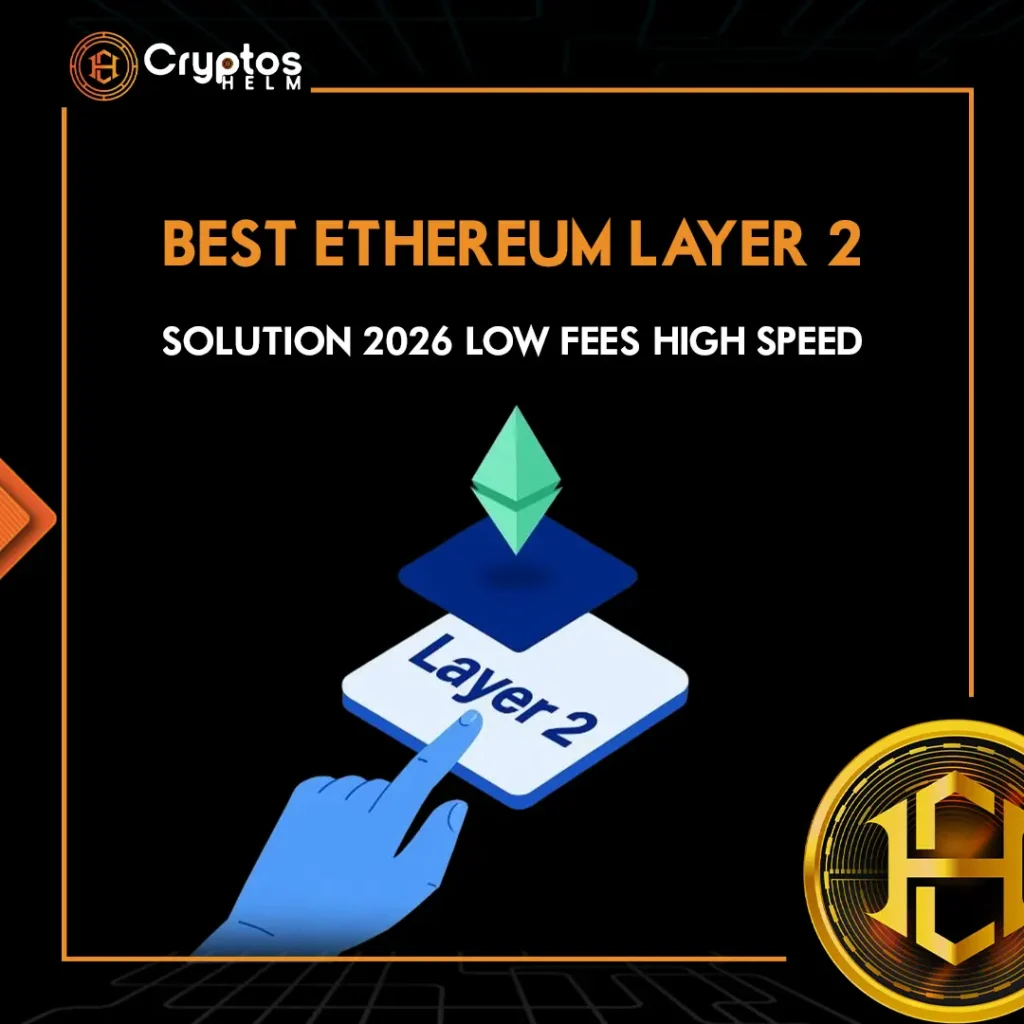
Introduction: Why Ethereum Needs Layer 2 in 2026
Ethereum remains the world’s most powerful smart contract blockchain. But it has one major problem — high transaction fees and slow speeds during peak usage.
In 2021, Ethereum gas fees reached $200+ per transaction. This made DeFi, NFTs, and everyday crypto use unaffordable for most users.
Layer 2 solutions were built to fix exactly this problem. As of 2026, Ethereum Layer 2 networks process millions of transactions daily at a fraction of Layer 1 costs — sometimes as low as $0.001 per transaction.
In this guide, we cover the best Ethereum Layer 2 solutions in 2026 — how they work, what makes each unique, and which one is right for you.
Want to know where Ethereum is headed?
Read our Ethereum Price Prediction 2026 guide.
What is Ethereum Layer 2? A Simple Explanation
Ethereum Layer 2 (L2) refers to secondary networks built on top of Ethereum (Layer 1) that process transactions off the main chain, then settle final results back on Ethereum.
Think of it this way:
- Layer 1 (Ethereum): The main highway — secure but congested and expensive
- Layer 2: Express lanes built alongside — faster, cheaper, but still secured by the main highway
How Layer 2 Works
- You initiate a transaction on the Layer 2 network
- Thousands of transactions are bundled together
- The bundle is compressed and submitted to Ethereum mainnet
- Ethereum verifies the bundle — providing full security
- You pay a fraction of normal Ethereum gas fees
This process is called rollup technology — the backbone of all major Layer 2 solutions in 2026.
Learn more about Ethereum’s consensus in our Proof of Work vs Proof of Stake guide.
Types of Layer 2 Solutions
Before diving into specific projects, understand the two main types:
Optimistic Rollups: Assume transactions are valid by default. Only verify if challenged. Faster but have withdrawal delays (7 days). Examples: Arbitrum, Optimism.
ZK Rollups (Zero-Knowledge): Use cryptographic proofs to verify every transaction instantly. More secure and faster withdrawals. Examples: zkSync, Polygon zkEVM, StarkNet.
Best Ethereum Layer 2 Solutions in 2026
1. Arbitrum — Most Adopted Layer 2 Network
Type: Optimistic Rollup | Token: ARB | TVL: $15B+
Arbitrum is the largest Ethereum Layer 2 by Total Value Locked (TVL) in 2026. Developed by Offchain Labs, it has become the go-to L2 for DeFi protocols and institutional users.
Key Features
- $15B+ TVL — largest L2 ecosystem
- 400+ dApps including Uniswap, Aave, GMX, Curve
- Transaction fees: $0.01–$0.10 average
- Transaction speed: 2,000+ TPS (transactions per second)
- Full EVM compatibility — Ethereum apps deploy without code changes
Who Should Use Arbitrum
DeFi users, traders, and developers who want the largest ecosystem with the most liquidity and lowest risk. Most major DeFi protocols have Arbitrum deployments.
Realistic Fee Savings
A swap that costs $15 on Ethereum mainnet costs approximately $0.05–$0.15 on Arbitrum — over 99% savings during peak congestion periods.
Learn more: arbitrum.io
2. Optimism — The Superchain Vision
Type: Optimistic Rollup | Token: OP | TVL: $8B+
Optimism is the second largest Ethereum L2 and the foundation of Coinbase’s Base network. Its Superchain vision — connecting multiple L2s into one unified network — makes it one of the most ambitious Layer 2 projects in 2026.
Key Features
- $8B+ TVL across Optimism and Base ecosystem
- OP Stack powers Base, opBNB, and 20+ other chains
- Transaction fees: $0.001–$0.05 average
- Retroactive Public Goods Funding — unique community funding model
- Coinbase Base partnership brings massive institutional adoption
Who Should Use Optimism
Users who want access to Coinbase’s Base ecosystem, developers building new L2 chains using OP Stack, and DeFi users seeking ultra-low fees.
Realistic Fee Savings
Post-EIP-4844 upgrade in 2024, Optimism fees dropped by 90%. Simple transfers now cost less than $0.001.
Learn more: optimism.io
3. zkSync Era — Leading ZK Rollup
Type: ZK Rollup | Token: ZK | TVL: $4B+
zkSync Era by Matter Labs is the leading ZK rollup in 2026. Unlike optimistic rollups, zkSync uses zero-knowledge proofs to verify every transaction mathematically — providing faster finality and stronger security guarantees.
Key Features
- ZK proof technology — mathematically verifiable security
- Instant withdrawals — no 7-day waiting period like optimistic rollups
- Transaction fees: $0.001–$0.03 average
- Native Account Abstraction — enables smart contract wallets by default
- ZK token launched 2024 with active community governance
Who Should Use zkSync Era
Security-conscious users, those who need fast withdrawals, and developers interested in cutting-edge ZK technology and account abstraction features.
Why zkSync Leads ZK Technology
zkSync’s native account abstraction allows users to pay gas fees in any token, set spending limits, and recover wallets — features not possible on other L2s. This makes it the most user-friendly ZK rollup available.
Learn more: zksync.io
4. Polygon zkEVM — Enterprise-Grade Layer 2
Type: ZK Rollup | Token: POL | TVL: $3B+
Polygon zkEVM combines the security of ZK proofs with full Ethereum Virtual Machine compatibility. It is the preferred Layer 2 for enterprise partnerships and institutional adoption in 2026.
Key Features
- Full EVM equivalence — any Ethereum app works without modification
- Enterprise partnerships: Starbucks, Nike, Reddit, JP Morgan pilots
- Transaction fees: $0.01–$0.05 average
- POL token — upgraded from MATIC with enhanced utility
- AggLayer — connects multiple chains into unified liquidity
Who Should Use Polygon zkEVM
Enterprises building on blockchain, developers who need full EVM compatibility with ZK security, and users accessing Polygon’s massive DApp ecosystem.
Enterprise Adoption Edge
Polygon’s partnerships with Fortune 500 companies give it a unique edge over pure crypto-native L2s. Its AggLayer technology in 2026 connects Polygon, Ethereum, and partner chains into unified liquidity — a major competitive advantage.
Learn more: polygon.technology
5. StarkNet — Most Powerful ZK Technology
Type: ZK Rollup (STARK proofs) | Token: STRK | TVL: $1B+
StarkNet by StarkWare uses the most advanced cryptographic technology in the Layer 2 space. Its STARK proof system is considered theoretically more secure than SNARK proofs used by zkSync and Polygon.
Key Features
- STARK proofs — quantum-resistant cryptography
- Cairo programming language — custom-built for ZK efficiency
- Transaction fees: $0.001–$0.02 average
- Unlimited scalability — theoretically no upper limit on TPS
- Used by dYdX v3 (largest crypto derivatives exchange) previously
Who Should Use StarkNet
Advanced developers, users prioritizing maximum security, and those interested in cutting-edge cryptography with long-term scalability potential.
Why StarkNet is Unique
StarkNet’s STARK proofs are quantum-resistant — meaning they remain secure even against future quantum computers. This gives StarkNet a long-term security advantage over all other Layer 2 solutions currently available.
Learn more: starknet.io
Layer 2 Comparison Table 2026
| Network | Type | Avg Fee | TPS | TVL | Best For |
|---|---|---|---|---|---|
| Arbitrum | Optimistic | $0.05 | 2,000+ | $15B+ | DeFi, Trading |
| Optimism | Optimistic | $0.001 | 2,000+ | $8B+ | Low fees, Base ecosystem |
| zkSync Era | ZK Rollup | $0.01 | 3,000+ | $4B+ | Security, Fast withdrawals |
| Polygon zkEVM | ZK Rollup | $0.02 | 2,500+ | $3B+ | Enterprise, EVM apps |
| StarkNet | ZK Rollup | $0.005 | 5,000+ | $1B+ | Advanced, Scalability |
How to Use Ethereum Layer 2 — Getting Started
Getting started with any Layer 2 takes just a few minutes:
- Set up a wallet — MetaMask or any Web3 wallet works
- Add the L2 network — go to chainlist.org and add your chosen L2
- Bridge funds — use the official bridge to move ETH from mainnet to L2
- Start transacting — use DeFi, NFTs, or send tokens at low cost
- Withdraw anytime — bridge back to mainnet when needed
Always use official bridges to avoid scams. Never use unofficial third-party bridges with large amounts.
Key Risks to Consider
Bridge Security: Most L2 hacks occur at bridge level. Only use official bridges and never bridge more than you can afford to lose.
Withdrawal Delays: Optimistic rollups (Arbitrum, Optimism) have 7-day withdrawal periods to mainnet without using third-party fast withdrawal services.
Ecosystem Maturity: Smaller L2s may have fewer dApps, lower liquidity, and higher smart contract risk than established networks.
Token Volatility: ARB, OP, ZK, POL, and STRK tokens are volatile. Network usage doesn’t guarantee token price appreciation.
Regulatory Risk: Layer 2 sequencers are currently centralized in most networks. Regulatory action against operators could impact network availability.
Also explore real-world blockchain opportunities in our Top 5 RWA Crypto Projects 2026 guide.
Frequently Asked Questions (FAQs)
What is Ethereum Layer 2 and why do I need it?
Ethereum Layer 2 is a secondary network built on top of Ethereum that processes transactions faster and cheaper. You need it because Ethereum mainnet fees can reach $10-$200 per transaction during busy periods. Layer 2 reduces these fees to $0.001-$0.10 while maintaining Ethereum’s security.
Which Ethereum Layer 2 has the lowest fees in 2026?
Optimism and StarkNet consistently offer the lowest fees in 2026, often below $0.001 per transaction for simple transfers. This is largely due to the EIP-4844 upgrade implemented in 2024 which reduced L2 data costs by over 90%. Actual fees vary based on network congestion.
Is it safe to use Ethereum Layer 2 networks?
Established Layer 2 networks like Arbitrum, Optimism, and zkSync have strong security records. However, risks exist — particularly at bridge level where most historical hacks occurred. Always use official bridges, start with small amounts, and verify contract addresses on official websites before transacting.
What is the difference between Optimistic and ZK rollups?
Optimistic rollups (Arbitrum, Optimism) assume transactions are valid unless challenged — they are simpler but have 7-day withdrawal delays. ZK rollups (zkSync, Polygon zkEVM, StarkNet) use cryptographic proofs to instantly verify every transaction — more secure with instant withdrawals but more complex to build on.
Do I need a different wallet for Layer 2?
No. The same MetaMask or Web3 wallet works on all Ethereum Layer 2 networks. You simply add the L2 network to your existing wallet using chainlist.org or the official network website. Your existing Ethereum address works on all L2 networks automatically.
Which Layer 2 is best for beginners in 2026?
Arbitrum is best for beginners due to its largest ecosystem, most liquidity, and widest dApp support. Optimism’s Base network (powered by Coinbase) is also excellent for beginners due to Coinbase’s trusted reputation and user-friendly onboarding. Both support all major DeFi protocols with minimal learning curve.
Conclusion: Which Layer 2 Should You Choose?
Ethereum Layer 2 solutions have matured significantly in 2026. High fees and slow speeds are no longer valid reasons to avoid Ethereum — Layer 2 networks handle millions of transactions daily at near-zero cost.
Quick Recommendation Guide:
- Best overall ecosystem: Arbitrum
- Lowest fees: Optimism / Base
- Best security: zkSync Era or StarkNet
- Best for enterprise: Polygon zkEVM
- Best for developers: StarkNet
The good news? You don’t have to choose just one. Most users maintain balances on 2-3 Layer 2 networks depending on which dApps they use.
Key Takeaways:
- Layer 2 reduces Ethereum fees by 95-99%
- Arbitrum leads with $15B+ TVL and 400+ dApps
- ZK rollups offer faster withdrawals and stronger security
- EIP-4844 made all L2 fees dramatically cheaper in 2024
- Always use official bridges — never unofficial third-party bridges
Ethereum Layer 2 is not just a scaling solution — it is the future of how billions of people will interact with blockchain technology.
About the Author
Sanan Saleem is a cryptocurrency analyst and blockchain technology researcher at CryptosHelm with over 11 years of experience since 2015. He specializes in Ethereum ecosystem analysis, Layer 2 scaling solutions, and DeFi protocol evaluation.
Connect: For more Ethereum analysis and blockchain guides, follow CryptosHelm on social media or visit our website for daily updates.
Join the CryptosHelm Community
Follow CryptosHelm for daily Ethereum updates, Layer 2 news, and blockchain technology analysis! Stay informed about scaling solutions, DeFi opportunities, and emerging crypto developments.
Visit CryptosHelm.com for comprehensive crypto guides, Ethereum analysis, and blockchain investment strategies!
Disclaimer: This article is for informational purposes only and does not constitute financial advice. Cryptocurrency investments carry significant risks including total loss. Layer 2 networks involve additional smart contract and bridge risks. Always conduct thorough due diligence and never invest more than you can afford to lose.