







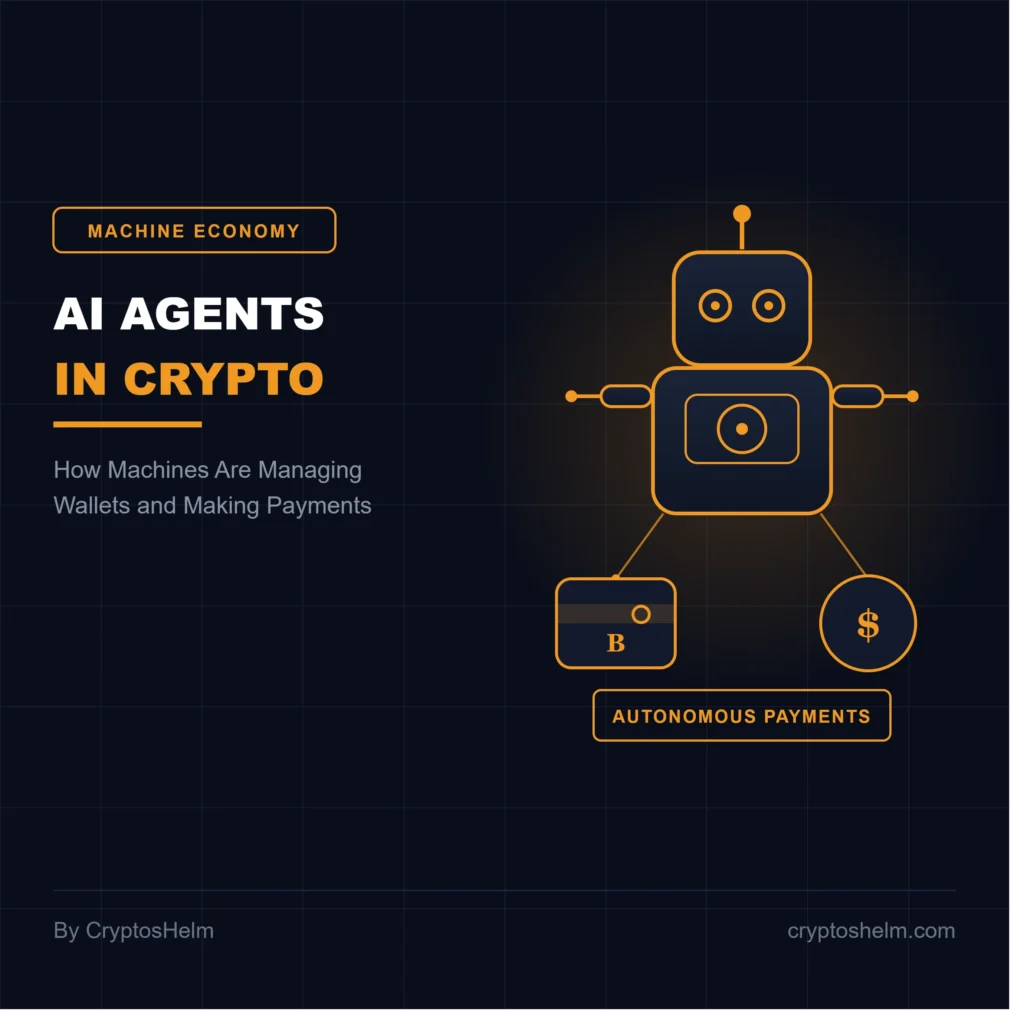
For years, crypto wallets had one thing in common: a human being had to click the button. That’s changing fast. AI agents in crypto are now holding their own wallets, executing trades, subscribing to data feeds, and paying other software directly, without a person approving every single transaction. This shift is often called the “machine economy,” and it’s quietly becoming one of the most important trends in the entire digital asset space.
In this article, we break down what AI agents in crypto actually do, how they manage wallets and payments, which projects are leading this space, and what risks come with letting software handle real money. Whether you’re a curious investor or someone trying to understand where crypto is heading next, this guide gives you a clear, practical picture.
What Are AI Agents in Crypto?
An AI agent, in the crypto context, is a piece of software that can make decisions and take actions on its own, based on goals it’s been given, rather than waiting for a human to approve each step.
Traditional crypto bots follow rigid, pre-programmed rules: “if price drops below X, sell.” AI agents go further. They can interpret data, adjust their strategy, communicate with other agents or services, and initiate payments, all without a person sitting at a keyboard.
Here’s a simple way to think about the difference:
| Feature | Traditional Trading Bot | AI Agent |
|---|---|---|
| Decision-making | Fixed rules only | Adapts based on data and context |
| Communication | None | Can interact with other agents/APIs |
| Payment ability | Usually requires manual trigger | Can initiate payments independently |
| Learning | Static | Can improve over time |
| Use case | Simple buy/sell automation | Portfolio management, data purchases, service payments |
This is why AI agents in crypto are being described as more than “smarter bots.” They’re closer to autonomous digital employees that happen to carry their own crypto wallets.
How AI Agents Actually Manage Wallets
The core idea behind an AI agent managing a wallet is fairly simple, even if the technology behind it is complex. Here’s how it typically works, step by step:
- Wallet creation The agent is assigned or generates its own crypto wallet, often on a blockchain built to support fast, low-cost transactions.
- Funding A human or organization deposits a limited amount of crypto into the agent’s wallet, similar to giving an employee a company card with a spending limit.
- Goal setting The agent is given instructions, such as “buy this data feed when price is under $5” or “pay for compute resources as needed.”
- Autonomous execution The agent monitors conditions and executes transactions on its own when those conditions are met.
- Reporting Activity is logged on-chain, so every payment the agent makes is transparent and traceable.
This structure matters because it keeps human oversight in the loop at the funding and goal-setting stages, while still allowing the agent to operate independently for day-to-day actions.
Why Crypto, Specifically, Works Well for AI Agents
You might wonder why AI agents are gravitating toward crypto rather than traditional banking rails. There are a few practical reasons:
- No bank account required. Software can’t open a traditional bank account, but it can hold a crypto wallet instantly.
- Programmable money. Crypto payments can be built directly into code, making them easy for an agent to trigger without human intervention.
- Micropayments are possible. Traditional payment rails often make very small transactions impractical due to fees. Crypto, especially on low-fee networks, makes tiny, frequent payments realistic.
- Global by default. An AI agent doesn’t care about borders, and crypto payments don’t require the agent to deal with currency conversion or international banking delays.
- Transparent activity. Every transaction is recorded on a public ledger, which is useful for auditing autonomous behavior.
This combination is why crypto is increasingly described as the “native currency” of the machine economy.
Real-World Ways AI Agents Are Being Used Today
AI agents in crypto aren’t just a theoretical concept. Here are some of the practical use cases already taking shape:
1. Portfolio Management Agents
These agents monitor market conditions and rebalance a crypto portfolio automatically, based on rules or learned patterns, without requiring the owner to log in and make manual trades.
2. Data and API Payment Agents
Some agents are designed to pay for access to data feeds, APIs, or compute resources on demand. Instead of a company signing a monthly subscription, an agent pays per use, only when it actually needs the resource.
3. Autonomous Service Agents
These agents can hire other digital services on behalf of a business process, such as paying for cloud storage, translation services, or specialized AI models, and settle the bill instantly in crypto.
4. Supply Chain and Logistics Agents
In more advanced setups, agents are being tested to manage parts of supply chains, automatically paying suppliers or logistics providers once certain on-chain conditions (like delivery confirmation) are met.
The Risks of Letting AI Agents Manage Crypto Payments
As exciting as this trend is, it comes with real risks that investors and businesses should understand before diving in.
| Risk | What It Means | How It’s Typically Managed |
|---|---|---|
| Spending limits | An agent could make unexpected payments if goals are poorly defined | Wallets are funded with capped amounts, not unlimited access |
| Smart contract bugs | Flawed code could be exploited to drain an agent’s wallet | Audits and gradual funding help limit exposure |
| Bad decision-making | An agent might misinterpret data and act incorrectly | Human oversight remains at the goal-setting stage |
| Security of the agent itself | If the AI system is compromised, its wallet is at risk too | Isolated wallets and monitoring reduce blast radius |
| Regulatory uncertainty | Rules around autonomous financial agents are still developing | Businesses are advised to stay cautious and compliant |
The general best practice right now is simple: never give an AI agent more funds than you’re comfortable losing entirely, at least while this technology is still maturing.
AI Agents vs. Traditional Automation: What’s Actually New?
It’s worth being clear-eyed here. Automated trading and payment systems aren’t new, crypto trading bots have existed for years. So what makes this moment different?
The real shift is autonomy combined with payment capability. A traditional bot needs a human to fund each transaction or operates within a tightly closed system, like an exchange. An AI agent can independently decide to pay another piece of software it has never “talked to” before, based on real-time conditions, and settle that payment instantly on a public blockchain.
This is the foundation of what’s being called the machine economy: a growing web of software systems that transact with each other directly, with humans setting the boundaries rather than approving every action.
What This Means for Everyday Crypto Investors
You don’t need to run an AI agent yourself to be affected by this trend. Here’s why it matters even if you’re a regular investor:
- New demand for fast, low-fee blockchains. Networks built for speed and micropayments are seeing increased attention because they’re better suited for agent-to-agent transactions.
- New categories of tokens are emerging. Some projects are specifically building infrastructure for AI agent payments, creating a niche worth watching.
- Increased on-chain transaction volume. As more agents transact autonomously, overall blockchain activity and network usage could rise.
- New security considerations. As this space grows, understanding wallet security becomes even more important, both for your own funds and for evaluating projects tied to agent infrastructure.
How to Get Started Safely (If You Want to Experiment)
If you’re curious about interacting with this trend as an investor or builder, here’s a sensible, cautious approach:
- Start with research, not funds. Understand how a specific AI agent platform works before committing any crypto.
- Use a separate, limited wallet. Never connect an agent to your main holdings.
- Set strict spending caps. Only fund what you can afford to lose completely.
- Monitor activity regularly. Autonomous doesn’t mean unsupervised, check transaction history often.
- Stay updated on regulation. This is a fast-moving space, and rules are still being written.
Frequently Asked Questions
1. What are AI agents in crypto?
AI agents in crypto are autonomous software programs that hold their own wallets and can make decisions, execute trades, or initiate payments without requiring a human to approve each individual action.
2. How do AI agents make crypto payments without human approval?
They operate within pre-set goals and spending limits defined by a human. Once those conditions are set, the agent monitors data and executes transactions automatically when the criteria are met.
3. Is it safe to let an AI agent manage my crypto wallet?
It carries risk, similar to any automated system handling money. Best practice is to use a separate, limited wallet with a capped budget rather than connecting an agent to your main crypto holdings.
4. What is the machine economy in crypto?
The machine economy refers to a growing network of AI agents and software systems that transact directly with each other using crypto, without requiring human involvement in every transaction.
5. Which blockchains are best suited for AI agent payments?
Fast, low-fee blockchains are generally preferred, since AI agents often need to make frequent, small transactions that would be impractical on networks with high fees or slow confirmation times.
6. Can AI agents lose money on their own?
Yes. If an agent misinterprets data, encounters a smart contract bug, or is given poorly defined goals, it can execute unwanted or harmful transactions, which is why spending limits are essential.
7. Do AI agents need a traditional bank account to operate?
No. This is one of the key advantages of crypto for AI agents, software can hold and use a crypto wallet instantly, without needing to open a bank account or go through traditional financial onboarding.
8. How is an AI agent different from a regular crypto trading bot?
A traditional bot follows fixed rules and typically requires human-triggered funding for each action. An AI agent can adapt to new information and independently initiate payments to other systems, even ones it hasn’t interacted with before.
9. What industries are exploring AI agent payments beyond trading?
Beyond portfolio management, AI agents are being tested for data and API payments, cloud service payments, and even supply chain and logistics use cases involving automatic supplier payments.
10. Is the machine economy regulated?
Regulation is still developing. Because AI agents making autonomous financial decisions is a relatively new concept, rules and oversight frameworks are expected to evolve significantly in the coming years.
Final Thoughts
AI agents in crypto represent one of the more genuinely new developments in the digital asset space, not just a faster trading bot, but software that can independently hold funds, make decisions, and transact with other systems in real time. The machine economy is still in its early stages, but the direction is clear: more of the crypto economy’s transaction volume will eventually involve machines paying machines.
For investors, this doesn’t mean handing over your portfolio to an algorithm overnight. It means understanding a trend that’s likely to shape blockchain infrastructure, transaction volume, and even new token categories over the next few years.
Want to stay ahead of the next big shift in crypto before it becomes mainstream news?
Subscribe to CryptosHelm for clear, practical breakdowns of emerging trends like AI agents, machine payments, and autonomous crypto infrastructure.
Disclaimer: This article is for informational purposes only and does not constitute legal, financial, or investment advice. AI agent technology and related regulations are evolving rapidly. Always do your own research and consult a licensed financial advisor before making investment decisions.